Why embedding model selection matters
Embedding models are AI models that capture "meanings" of objects by turning text, images, audio and more into sequences of numbers.
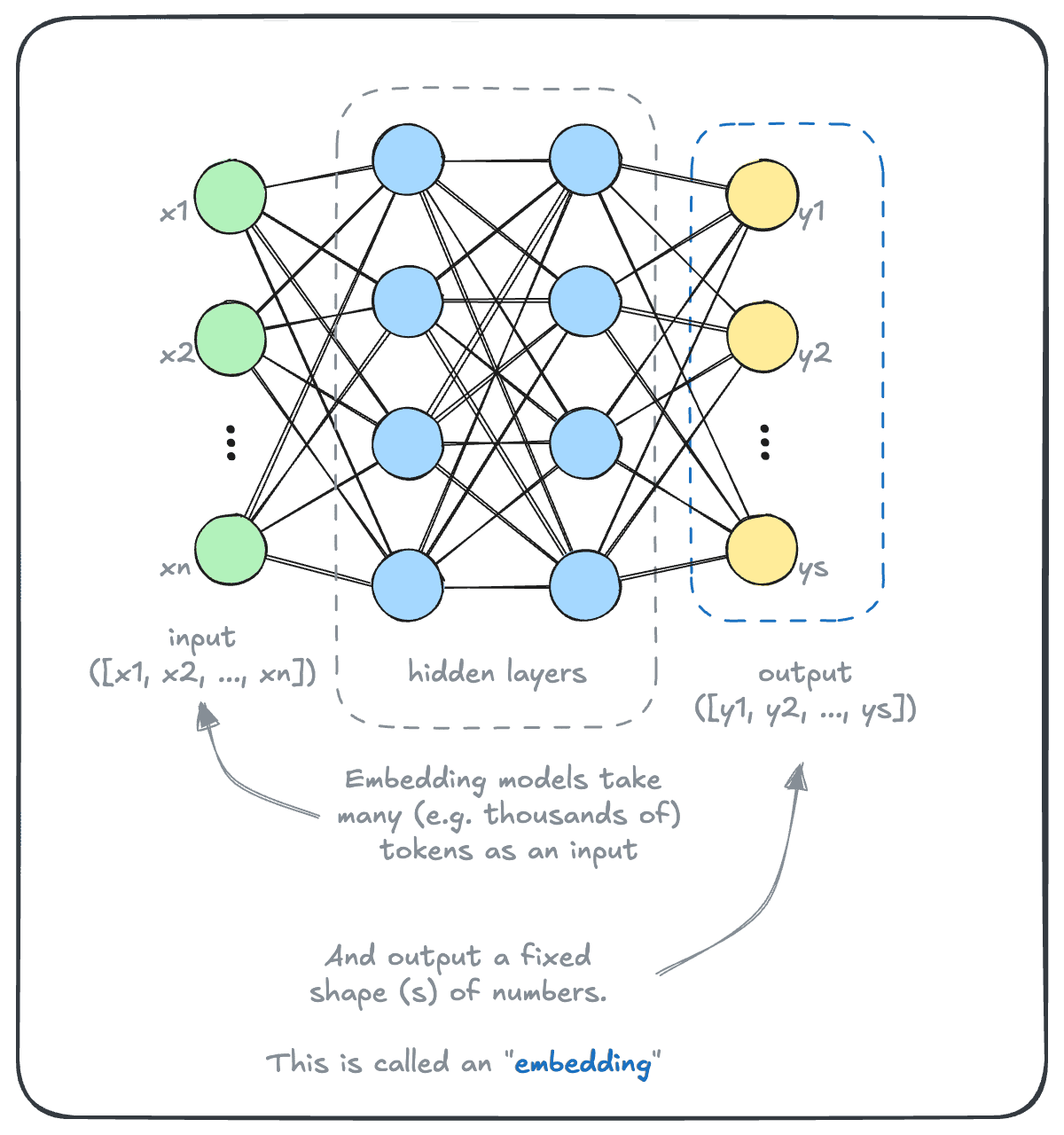
Recent developments have greatly improved their capabilities, but this also makes model selection challenging with a vast set of ever-expanding options.
The performance gap
Let's look at a concrete example comparing two models from different eras:
- FastText (2015): An early embedding model
- Snowflake Arctic Embed (2024): A modern embedding model
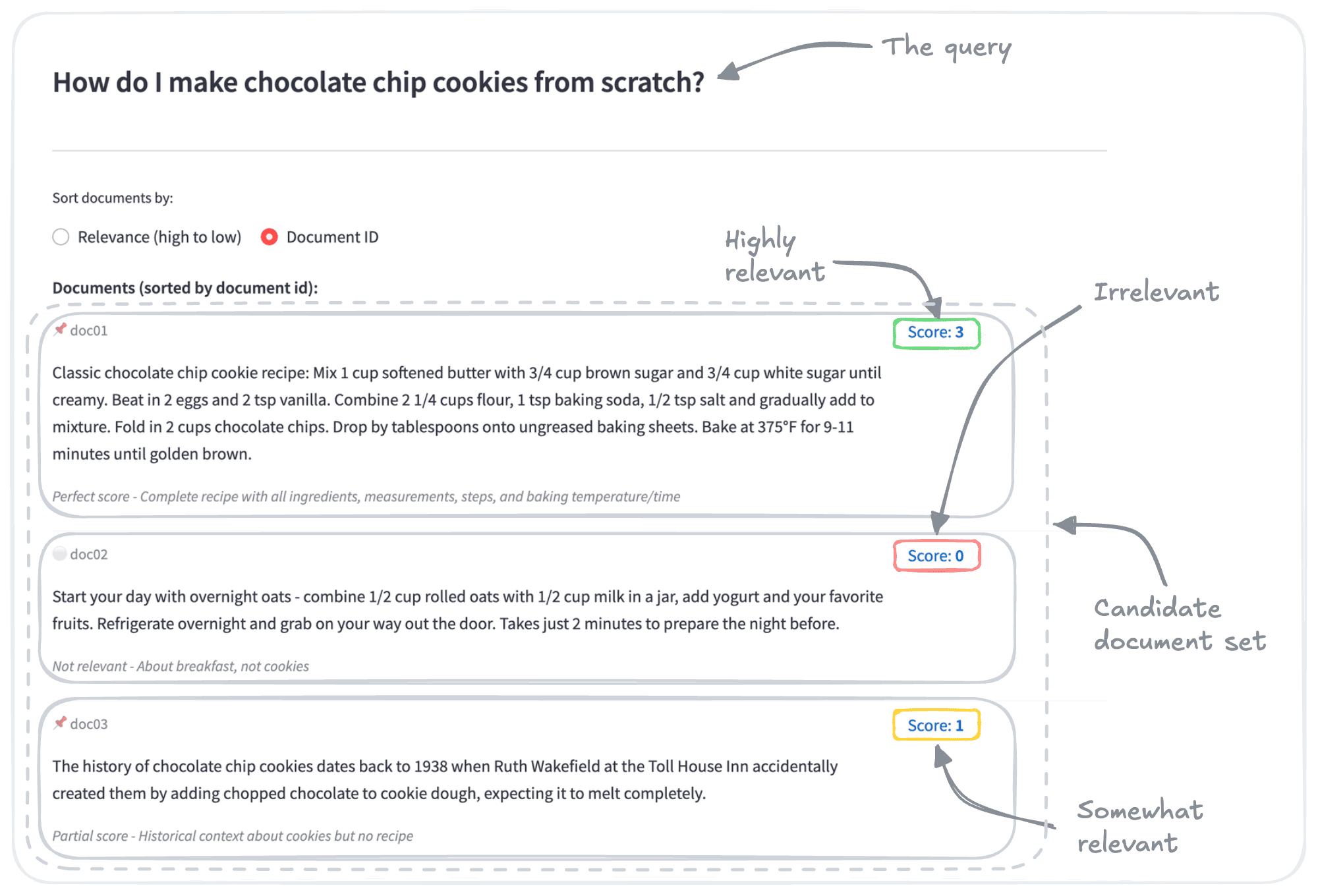
When searching for documents matching "How do I make chocolate chip cookies from scratch" in a dataset of 20 documents, here's what we see:
FastText results:
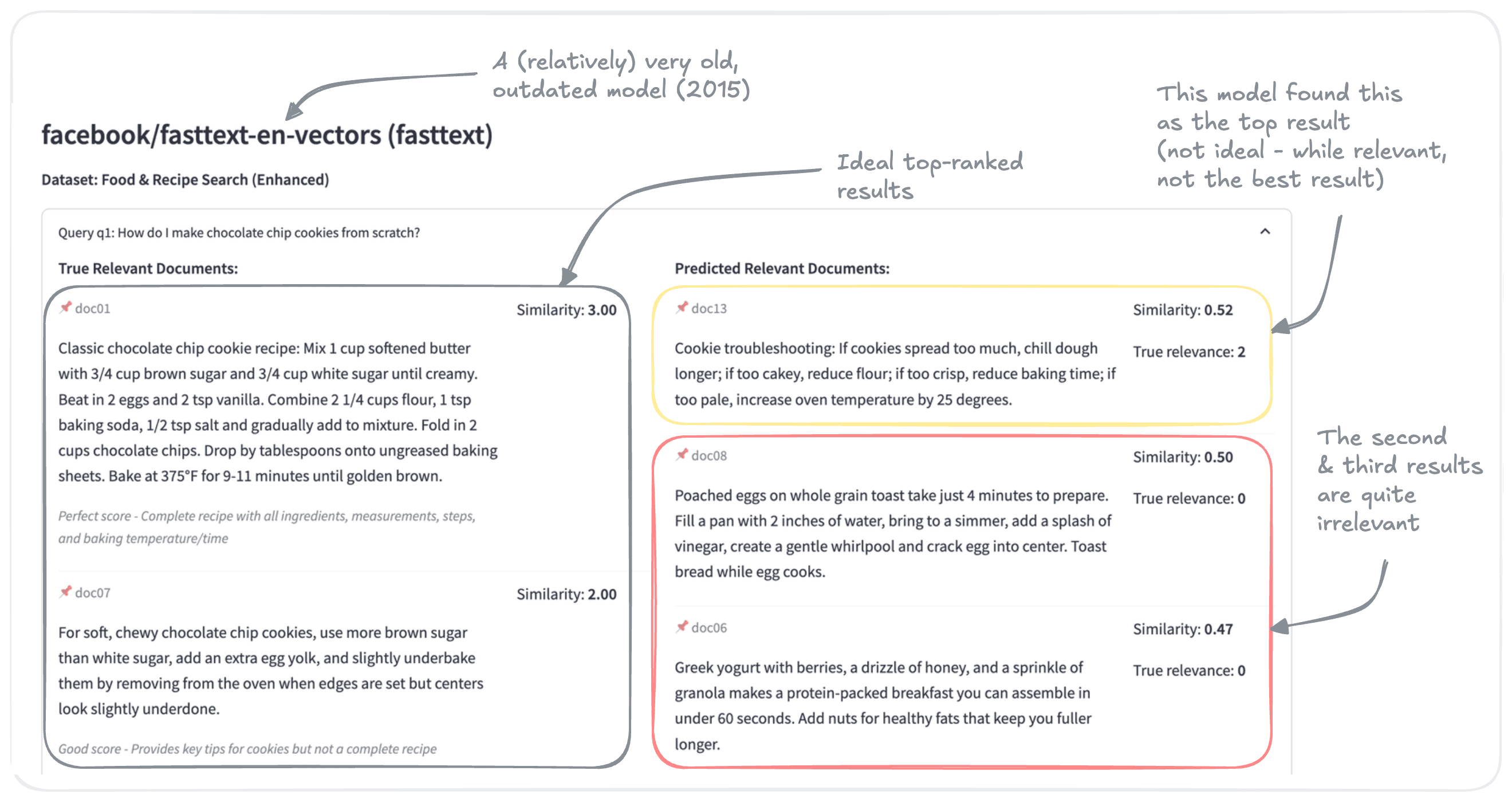
The FastText model finds somewhat relevant results, but includes off-topic recipes and misses the ideal step-by-step recipe.
Arctic Embed results:
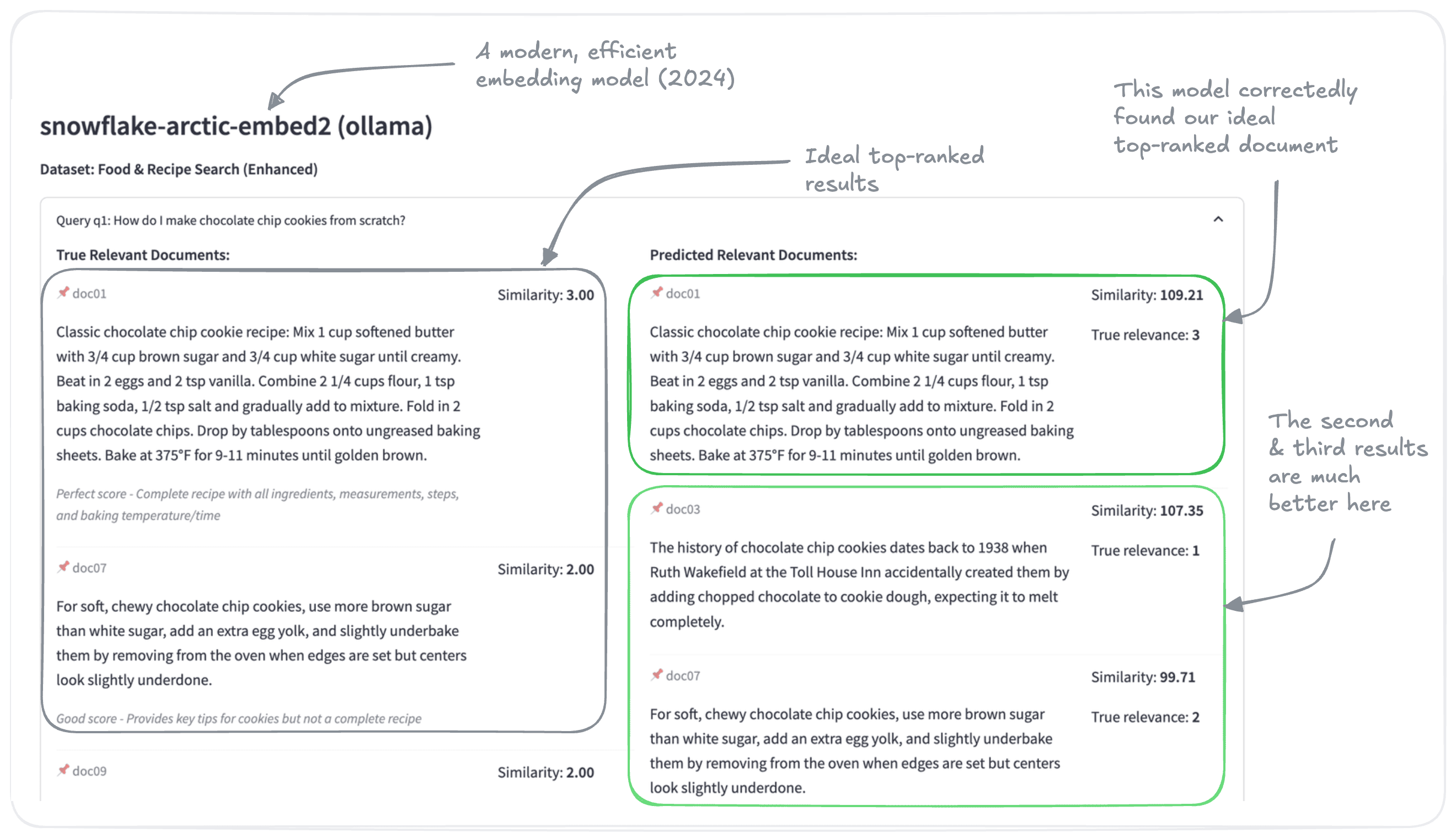
The Arctic model correctly identifies the ideal result as the top match and includes highly relevant results in the top positions.
Quantitative comparison
Using the nDCG@10 metric (which rewards relevant results at the top of the list):
| Model | nDCG@10 |
|---|---|
| FastText | 0.595 |
| Snowflake Arctic | 0.908 |
This dramatic improvement shows why model selection matters for retrieval quality.
Resource implications
Beyond performance, models vary significantly in resource requirements:
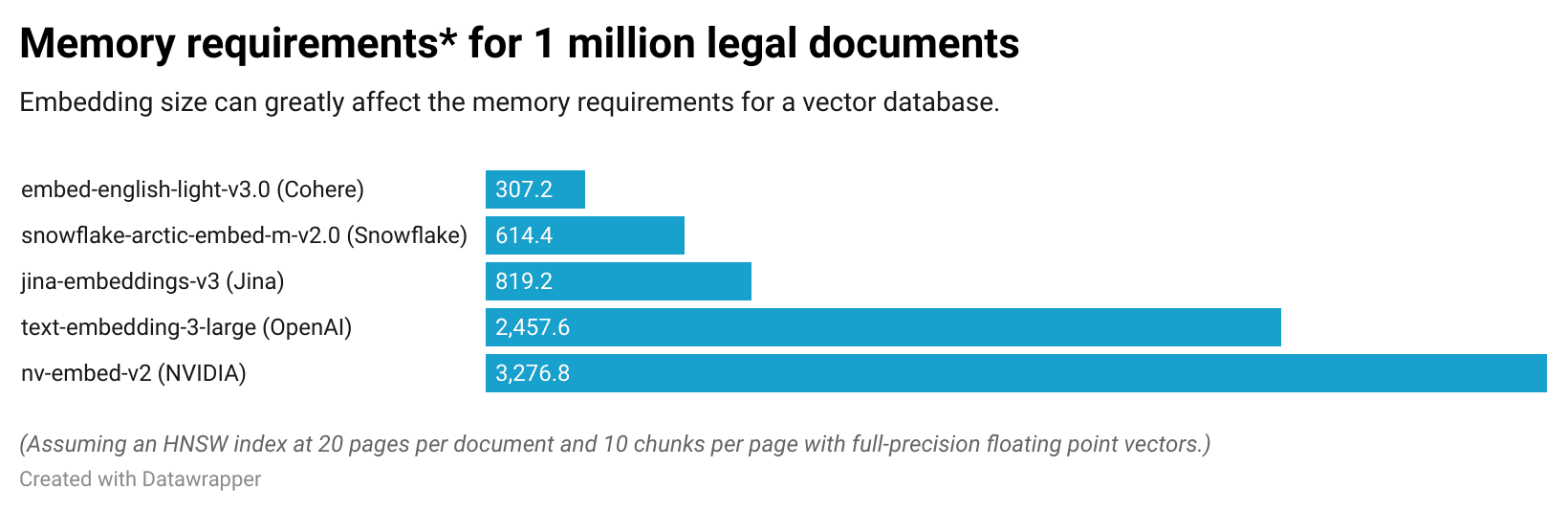
Read the assumptions in that chart's footnote before you quote its numbers. It models 1 million legal documents at 20 pages each and 10 chunks per page, so it is sizing 200 million full-precision vectors in an HNSW index, not 1 million:
- High-dimension model (nv-embed-v2, 4096 dimensions): ~16 KB per vector → ~3.3 TB for 200M vectors
- Low-dimension model (embed-english-light-v3.0, 384 dimensions): ~1.5 KB per vector → ~300 GB for 200M vectors
Per-vector is the number that travels safely: 1 million vectors from those same two models would be about 16 GB and 1.5 GB. What holds at every scale is the ratio: a ~10x difference in dimensionality is a ~10x difference in memory, and it lands directly on infrastructure costs and deployment feasibility.
The challenge of choice
The embedding model landscape includes innovations like word2vec, FastText, GloVe, BERT, CLIP, OpenAI ada, Cohere multi-lingual, Snowflake Arctic, ColBERT, and ColPali. Each brings improvements in architecture, training data, methodology, modality support, or efficiency.
With hundreds of models available and new ones released regularly, making the right choice requires a systematic approach.
Now that you understand why embedding model selection is crucial, let's explore a systematic workflow that will guide you through this complex decision-making process.