Overview
Weaviate is an open-source vector database designed for AI applications (GitHub). You might also call it an AI-native database, because Weaviate was built with AI at its very core.
As a production-ready, AI-native database, it can be a key component of your AI development stack by:
- Providing an end-to-end solution for retrieval-augmented generation (RAG)
- Supporting a wide range of data types and modalities, including text, images, and more
- Boosting developer productivity through intuitive API design and AI model integration
- Enabling developers to prototype quickly, and then move to production at scale without friction
This course introduces you to Weaviate and its capabilities as a vector database. It is a concepts course: the one code sample you will see is there to illustrate a point, not as a hands-on exercise. When you want the hands-on version, the Weaviate documentation is the reference this course sits on top of, and its Quickstart gets you to a working instance in a few minutes.
Vector database vs traditional database
Retrieving the right data and connecting to AI models is key to building a powerful, modern AI-powered application. And vector databases excel at retrieving the most relevant data for your needs, based on the meaning of objects.
Imagine a user searching for "blue backpack" on an e-commerce search engine. A site using a traditional database may only pick up entries containing either of those exact words.
Not with a vector database. Weaviate can identify all entries based on similarity of meaning.
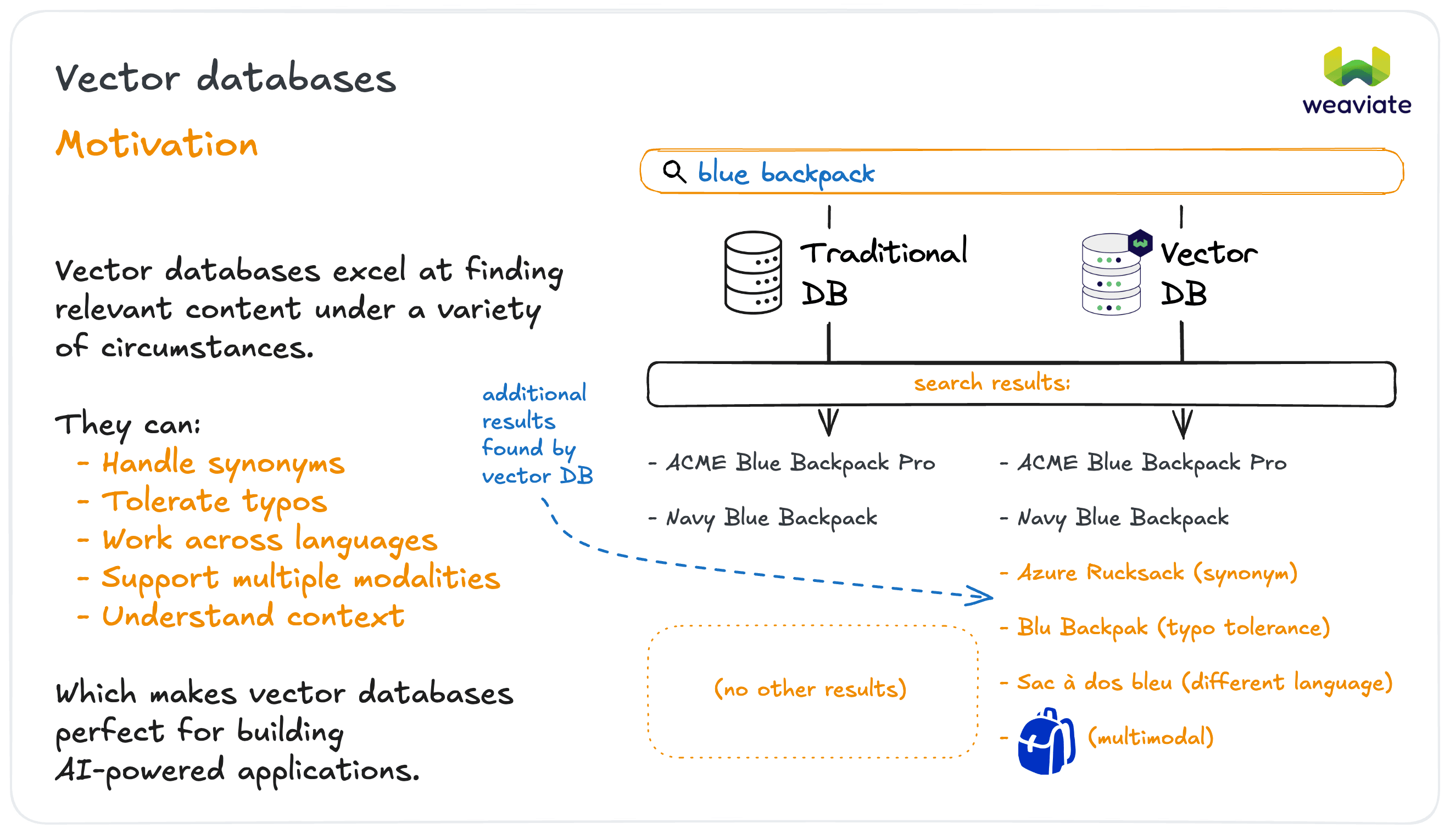
Vector databases like Weaviate can:
- Handle synonyms - Find "rucksack" when you search for "backpack"
- Tolerate typos - Return relevant results even with spelling mistakes
- Work across languages - Search in English, find results in French or Spanish
- Support multiple modalities - Search with text and find relevant images, or vice versa
- Understand context - Distinguish between "apple" the fruit and "Apple" the company
This makes Weaviate a perfect fit for building AI-powered applications. Weaviate can bridge the gap between your data and AI models, making it possible to build applications that truly understand context and meaning.
Common Use Cases
So what does this mean in practice? Here are the problems vector databases solve that developers encounter:
Semantic Search Challenge
Your users search for "laptop bag" but your database only finds exact matches. They miss the "computer backpack" and "notebook carrying case" that would be perfect fits.
With Weaviate: One search finds all semantically similar products, increasing conversion rates
Content Discovery Challenge
You have thousands of support articles, but users can't find the right one. "WiFi won't connect" should find "wireless connectivity issues" - but traditional search fails.
With Weaviate: Support tickets get routed to relevant solutions automatically, reducing resolution time
Computational Scaling Challenge
You want to build recommendation features, but comparing every item to every other item doesn't scale past a few thousand records.
With Weaviate: Vector indexes efficiently scale search, powering real-time recommendations on even billions of items.
Now that you understand why vector databases are important, let's explore the core concepts that make this possible. These concepts are key to understanding how vector databases work, and how they can be used in AI applications.